



In Myeh-delaide (Part 1), we reviewed examples of simmering national disdain of Adelaide. These negative perspectives seem to centre on visitor experiences of the city, yet are contradicted by deep local affection for the place – and by much of Adelaide that is actually very good.
How can we make sense of these differences? Here’s Part two…
We left the previous discussion with a suggestion that deeper insights of Adelaide’s real condition might be obtained by applying a comparative approach.
Let’s start by reviewing a couple of noteworthy exotic projects that share many attributes of counterparts proposed for Adelaide, and extract from this comparison a hint of the urban-design merit of the place.
Santa Caterina Market, Barcelona
Barcelona is generally well loved by those lucky enough to have visited it.
Though the Cerda-grid layout may be better known to planners than Adelaide’s Colonel Light-grid, popular regard for Barcelona rests on its rich urban life and its many remarkable buildings; from its historic core, the striking works of Antonio Gaudi, legacies of its Olympic hosting, and more recently many smaller projects such as the Mercat Santa Caterina (title image).
MORE FROM MIKE BROWN’S SERIES ON PLANNING IN ADELAIDE:
- Myeh-delaide – Australia’s emerging capital of urban mediocrity
- Naffelaide: “…time for Adelaide to just grow up”
- Radelaide – the worship of cars in the City of Churches
- Radelaide – from “big country town” to the towers of “Sad Gimignano”
- Happilaide? Adelaidean born and fled – why do its citizens leave to succeed?
Designed by well-known local firm EMBT, the market was an integral part of a local rejuvenation project, which also included public space upgrades and refurbished and new residential development (the light-coloured buildings behind the market in the title image).
As well as serving its neighbourhood, the market has become a notable tourist attraction, even included in Monocle magazine travel guide to the city.
Santa Caterina is actually one of many noteworthy contemporary developments across a city that never seems to fatigue in generating delightful urban surprises.
Significantly, the entire project was the result of a competition run by and for the city government and its many communities.
An aside: note in the title image the scale of surrounding development. Though the city has pockets of taller development, the Cerda grid accommodates one of the highest population densities amongst European cities.
New leisure and aquatic centre for Green Square
Located midway between Kingsford Smith Airport and central Sydney, the suburb now known as Green Square was originally swampland, then a racetrack, then an industrial area before declining into contaminated under-use.
Since the start of this century, Green Square has been decontaminated and redeveloped to become one of the densest urban centres in Australia.
The city council held land parcels in the area for many years and arguably benefited when many, including this site, were rezoned to accommodate medium-rise mixed use redevelopment.
Yet, instead of cashing in on this windfall, the council ran a competition to develop a new community facility for its growing population.
Designed by a consortium of architects, along with the council client, the centre won many architecture and other awards.
The Gunyama (Green Square) Aquatic Centre is a striking facility (refer image below).

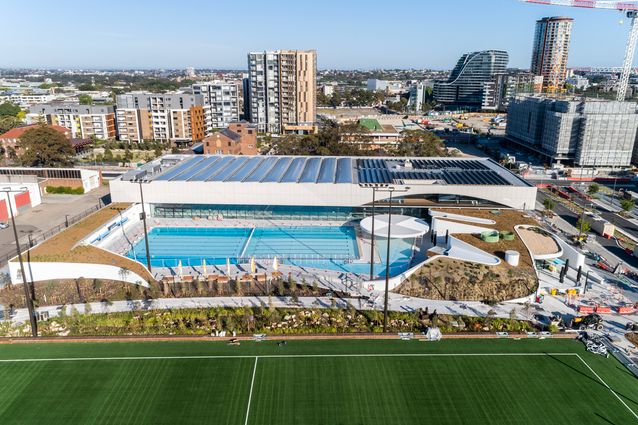
Located on land for which 10 storeys was permitted, its low-rise form conveys powerful messages of council’s commitment to community and public interests, in sharp contrast to the medium-to-high rise development that continues to jostle around it in a way all too familiar to many Sydney-siders.
Now let’s compare both of these examples with development about to commence in Adelaide
Adelaide’s Market Central
Long loved by residents and envied by visitors, Adelaide’s central market seemed to be the left-over bits of many buildings, none quite finished. Parts of the market are owned by the local council, the rest and by private owners.
The overall precinct is close to Victoria Square, Adelaide’s central open space, located behind state-owned law-courts and an international hotel, which is built on land also owned by the city council.
A ground level collection of privately-owned arcades feed into the well-known council-owned market-stall area. A variety of heritage façades bound the lower two levels, above which a two-level car park meanders over most of the complex.
Distinguished by ad-hoc accretions, the complex accumulated a Chinatown and many restaurants and now gives its name to a slightly down-at-heel multi-block multi-ethnic precinct that was unusual for Adelaide. Melbourne’s Queen Victoria Market was its closest interstate relative.
Just like the Santa Caterina site in Barcelona, part of Adelaide’s central market will be redeveloped (see image below), directly adjacent to that part owned by the council (left in the image).


Retaining the heritage facades – just like Santa Caterina – Council’s website proclaims, it will “…be a catalyst for enriching the city … and a flagship mixed-use development of national significance” (emphases added).
Thus setting the tone, the rest of the claims are worth extensive quotation in order to assist what the reader may now suspect being invited to do.
“The flagship mixed-use development will add an icon to the Adelaide skyline and will ensure our world-renowned market district will continue to be embraced as the central heart of the city for locals and an unmissable spot to visit for tourists…”
“The iconic Adelaide Central Market will be expanded to connect seamlessly into Market Square which includes new residences, offices, a premium hotel, retail and activated public spaces consisting of an elevated 3,000 square metre terrace.”
“Featuring local and unique retailers showcased the best of South Australia, with just the right blend of high-end eateries and hospitality offerings, will (sic) create and support a night-time economy…”
“A new social and commercial heart for Adelaide, the project will elevate the market district as a premier precinct showcasing the very best of South Australian food, wine and produce”.
“These (pedestrian) links will contribute to a thriving laneway culture and support public art.”
“A new terrace, offering 3,500 (sic) square metres of green space, will be accessible to all and will become a key community hub.”
For the relentlessly curious, Council’s website provides helpful FAQ’s and Current Status, along with the name of the project manager for this essentially private development.
But wait, there’s more – Adelaide is abuzz!!!
Ground-breaking development in North Adelaide!!!
Redevelopment of the Le Cornu site in North Adelaide aroused controversy for decades.
Originally, relatively low-rise development was proposed by its then owner but was staunchly opposed by the Adelaide City Council, which eventually negotiated to purchase the long-vacant land for $34 million with a promise to provide new community facilities, all expressed in a masterplan that was supported by the community.
Yet, Council is now a “development partner” of a much larger development, now called Eighty-Eight O’Connell, and will receive $25.5 million in “commercial returns”, plus rate revenue.
When complete, the development will comprise two 13-storey and a central 15-storey tower set behind a low-rise podium – a development format familiar to most east-coast city dwellers (see image below).


Following a joint developer and Lord Mayor sod-turning ceremony, redevelopment has commenced.
A news report of the event contains the usual jumble of pro-development tropes – triumphalism, didactic instruction, glee, and hyperbole – which are worth quoting extensively here for the same reason as are those for Market Central (emphases added).
“The development’s three towers will be connected by a “multi-functional podium” and include access to indoor and outdoor swimming pools, as well as a gym, spa and sauna.”
“I think we’ve gotten rid of the vocal minority and we can get on and get the job done now.”
“I can remember back when there was a lot of opposition to this thing called the Adelaide Oval redevelopment and I don’t hear those people anymore. I heard opposition when people talked about trams and I don’t hear them anymore and I think that this is a good time for the narrative just to grow up in Adelaide.”
“An outdoor terrace – to be called “Sky Park” – will be accessible to the public and be used to host community events, while 405 off-street car parks will be built over three basement levels.
“The park up there is actually something that people can come and use (sic)…We’re keeping it open as a privately-owned space so that we can curate and use it and keep it clean and do all those things that councils would find hard to do to be able to tend to that particular land.
“(Lord Mayor) Verschoor said she hoped that those who opposed the development would “grow to enjoy and love what is going to be here. “This will be a destination – more than anything we need to enliven the precinct and this is an absolute catalyst for that reinvigoration,” she said.”
Hmmm, this is all very interesting, what do you think?
To be clear, neither the designers – who are very good – nor the developers are the focus of our attention here. In both of these examples, they are all doing what they are good at and are meant to do.
Of the many themes embedded in these accounts, we are interested in just a few; the relative roles and responsibilities of designers, developers, communities and governments in shaping the city; the significance if any of urban attractiveness and tourism appeal; the dominant forces accommodated in urban change, and not least; the importance of an animating urban vision.
We will touch on these themes in future iterations of this series.
In the meantime, and recalling Churchill’s formulation – we shape our buildings and thereafter they shape us – we can ask, what do these two Adelaide developments exemplify?
This is where you, dear reader, can contribute.
What do you think of the claims (highlighted) made for each of the Adelaide developments above? Do you think those who opposed the developments are fairly characterised? What do you think of the council’s relationship to each of the developments? Do you think they will become the catalysts, icons and centres of revitalisation as claimed? Is Adelaide about to experience a sharp up-tick in tourists keen to visit these two attractions?
Finally and in summary, having compared Barcelona’s Santa Caterina Market with Adelaide’s Central Market development – and the Gunyama Aquatic Centre with Adelaide’s Eighty-Eight O’Connell – which descriptor do you think would best summarise each Adelaide example along the axis of Crapelaide, Sadelaide, Naffelaide, Myeh-delaide, Happilaide, Radelaide Fabulaide or Spectaculaide?
MORE FROM MIKE BROWN’S SERIES ON PLANNING IN ADELAIDE:
- Myeh-delaide – Australia’s emerging capital of urban mediocrity
- Naffelaide: “…time for Adelaide to just grow up”
- Radelaide – the worship of cars in the City of Churches
- Radelaide – from “big country town” to the towers of “Sad Gimignano”
- Happilaide? Adelaidean born and fled – why do its citizens leave to succeed?
MORE FROM THE FIFTH ESTATE ABOUT URBAN PLANNING IN SOUTH AUSTRALIA:
- SA has a lot to crow about with power – but faces some sustainability challenges beyond the “Stobie” poles
- Heritage or higher density: Peter Malinauskas’ big dilemma over South Australia’s planning laws
- Now he’s PM, Anthony Albanese can help Malinauskas get Adelaide’s tram plans back on track
